How much protein do you actually need in menopause?
The old "0.8 grams per kilogram" advice wasn't written for a woman losing estrogen and fighting to keep her muscle. Answer four questions and get your daily protein target from the most recent research, with every number cited below.
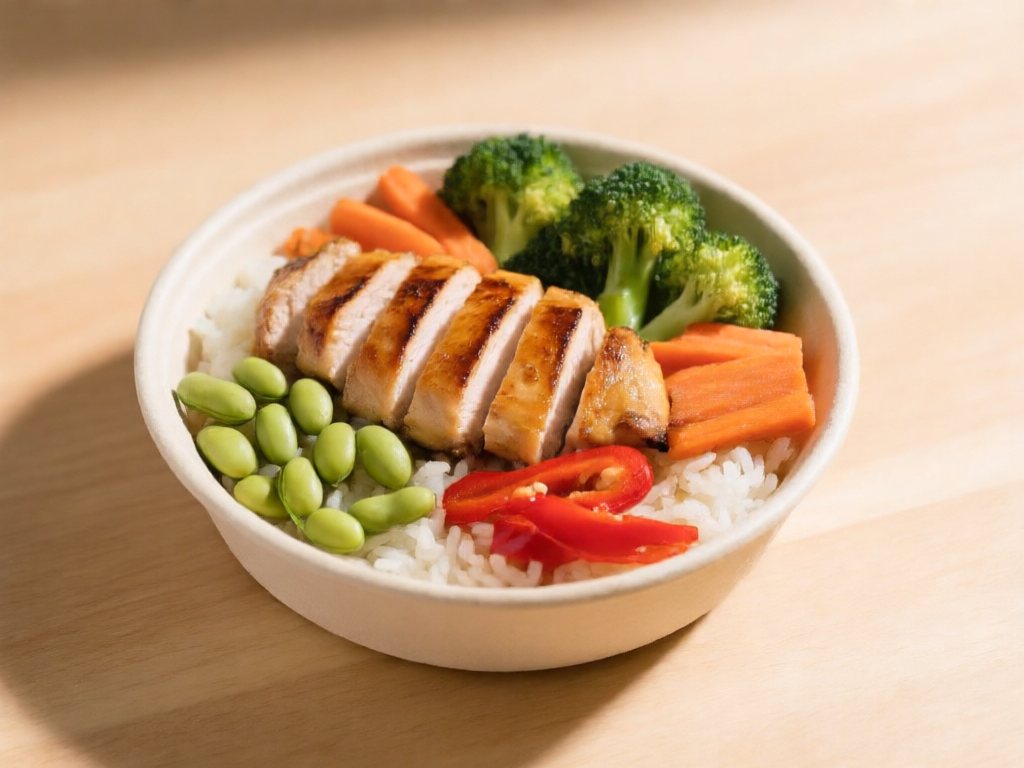
How to split it up
Aim for 25–40 g at each meal rather than saving it all for dinner; older muscle needs a real dose at every sitting to trigger muscle building.
What ~30 g of protein looks like
- 4 oz cooked chicken breast, salmon, or lean beef
- 1 cup cottage cheese plus a handful of almonds
- 1 cup Greek yogurt with a scoop of protein powder
- 3 eggs plus 1 oz cheese and a glass of milk
A note on the number: if you're carrying a lot of excess weight, base your target on your goal weight, not today's, so it isn't inflated. These ranges assume healthy kidneys; if you have moderate-to-severe kidney disease, talk to your doctor before raising protein. This is education, not medical advice, especially on a GLP-1 medication.
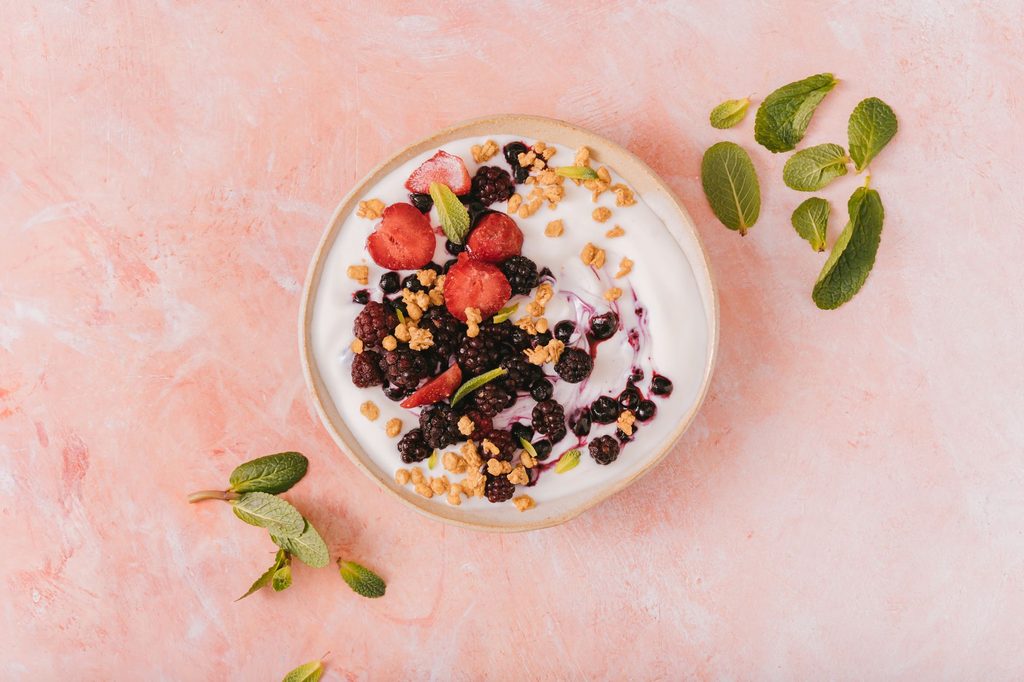
Get your free 7-day protein plan
Now that you have your number, let me help you actually hit it. Enter your email and I'll send you a free, printable 7-day meal plan built around real recipes and shaped to land on your target, plus 50+ more high-protein recipes from my own kitchen.
It's free, it's yours to print, and you can unsubscribe anytime.
Why so much more than the RDA?
The RDA of 0.8 g/kg was set as the minimum to prevent deficiency in healthy adults. It was never the amount that keeps a midlife woman strong. Two things change the math after 40: your muscle becomes less responsive to protein (researchers call it anabolic resistance), and falling estrogen accelerates the loss of muscle and bone. The practical consequence is that the same meal that built muscle at 30 barely maintains it at 55.
That's why aging-muscle expert groups and recent trials consistently land between 1.2 and 1.6 g/kg per day for women our age, with the top of the range for anyone lifting weights or eating in a calorie deficit. On a GLP-1 medication the stakes are higher still: appetite drops so fast that protein is usually the first thing to collapse, and a meaningful share of the weight lost can be muscle unless protein and resistance training hold the line.
Distribution matters too. Muscle protein synthesis is triggered per meal, and in midlife it takes roughly 25–40 g at a sitting to flip that switch. Three coffees and a big dinner won't do it.
What 30 g of protein actually looks like
Your target only helps if you can picture it on a plate. Here's roughly 30 g of protein, a solid single-meal dose, from a dozen everyday foods. Amounts are approximate, just enough to calibrate your eye.
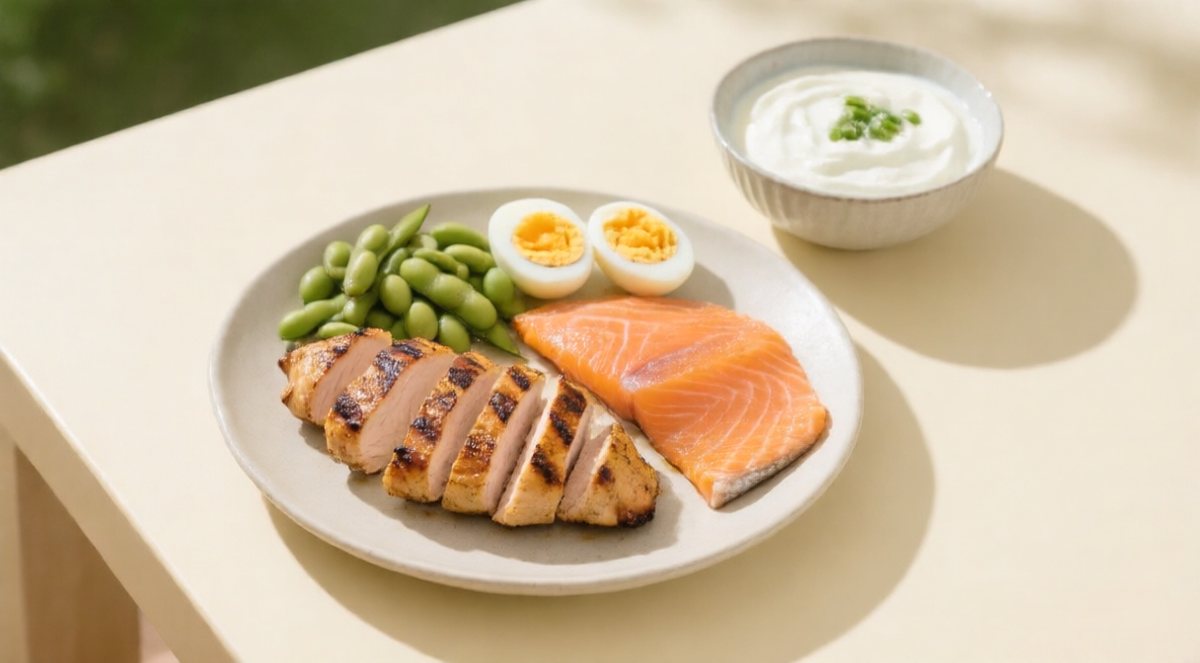
- 4 oz Cooked chicken breast about the size of your palm
- 4 oz Salmon fillet
- 4 oz Lean steak or 90% ground beef
- 1 can Canned tuna
- 6 oz Cooked shrimp
- 1 cup 2% cottage cheese
- 1.25 cups Plain Greek yogurt
- 1 scoop Whey protein
- 5 eggs Large eggs
- 3 oz Cheddar cheese higher in fat, so pair it
- Plant 1 cup + 2 tbsp Lentils plus hemp seeds
- Plant 5 oz + 1/2 cup Firm tofu plus edamame
Wait, isn't all that protein hard on your kidneys?
For healthy kidneys, the short answer is no. A meta-analysis of 28 studies found that higher-protein diets don't change kidney function in healthy adults (Devries 2018).
A full year of eating 2.5 to 3.3 g per kg, far more than this tool will ever suggest, did no harm to kidney or liver markers in one study (Antonio 2016). And a 2024 review of more than 148,000 people found that higher protein intake was linked to a lower risk of chronic kidney disease, not a higher one (Cheng 2024).
The one real caveat: if you already have kidney disease, your protein target needs to be set with your doctor. This tool is written for women with healthy kidneys.
Why I built this
I'm Annette, a medical technologist by training. I'm on Mounjaro, I lift, and I carry two copies of APOE4, so keeping muscle isn't a vanity project for me; it's my long-game plan for staying strong and independent. When I went looking for a simple, honest answer to "how much protein do I actually need now," everything I found was either written for 25-year-old bodybuilders or stuck on the 1970s RDA. So I read the research and built the tool I wanted. Every number above traces to a study you can check yourself in the references below.
Prefer Substack? Subscribe here.
References
- Bauer J, et al. (2013). Evidence-Based Recommendations for Optimal Dietary Protein Intake in Older People: A Position Paper From the PROT-AGE Study Group. J Am Med Dir Assoc. doi:10.1016/j.jamda.2013.05.021
- Deutz NEP, et al. (2014). Protein intake and exercise for optimal muscle function with aging: Recommendations from the ESPEN Expert Group. Clinical Nutrition. doi:10.1016/j.clnu.2014.04.007
- Jäger R, et al. (2017). International Society of Sports Nutrition Position Stand: Protein and exercise. J Int Soc Sports Nutr. doi:10.1186/s12970-017-0177-8
- Moore DR, et al. (2015). Protein Ingestion to Stimulate Myofibrillar Protein Synthesis Requires Greater Relative Protein Intakes in Healthy Older Versus Younger Men. J Gerontol A Biol Sci Med Sci. doi:10.1093/gerona/glu103
- Black KE, Matkin-Hussey P. (2024). The Impact of Protein in Post-Menopausal Women on Muscle Mass and Strength: A Narrative Review. Physiologia. doi:10.3390/physiologia4030016
- Menzies A, et al. (2026). Menopause, Female Sex Hormones, Skeletal Muscle Mass and Muscle Protein Turnover in Humans. J Cachexia Sarcopenia Muscle. doi:10.1002/jcsm.70232
- Geraci A, et al. (2023). The role of estrogen in female skeletal muscle aging: A systematic review. Maturitas. doi:10.1016/j.maturitas.2023.107844
- Dam TV, et al. (2021). Transdermal Estrogen Therapy Improves Gains in Skeletal Muscle Mass After 12 Weeks of Resistance Training in Early Postmenopausal Women. Front Physiol. doi:10.3389/fphys.2020.596130
- Neeland IJ, et al. (2024). Changes in lean body mass with glucagon-like peptide-1-based therapies and mitigation strategies. Diabetes Obes Metab. doi:10.1111/dom.15728
- Devries MC, et al. (2018). Changes in Kidney Function Do Not Differ between Healthy Adults Consuming Higher- Compared with Lower- or Normal-Protein Diets: A Systematic Review and Meta-Analysis. The Journal of Nutrition. doi:10.1093/jn/nxy197
- Antonio J, et al. (2016). A High Protein Diet Has No Harmful Effects: A One-Year Crossover Study in Resistance-Trained Males. Journal of Nutrition and Metabolism. doi:10.1155/2016/9104792
- Cheng Y, et al. (2024). Association between dietary protein intake and risk of chronic kidney disease: a systematic review and meta-analysis. Frontiers in Nutrition. doi:10.3389/fnut.2024.1408424
- van Vliet S, Burd NA, van Loon LJC (2015). The Skeletal Muscle Anabolic Response to Plant- versus Animal-Based Protein Consumption. The Journal of Nutrition. doi:10.3945/jn.114.204305
- Herreman L, et al. (2020). Comprehensive overview of the quality of plant- and animal-sourced proteins based on the digestible indispensable amino acid score. Food Science & Nutrition. doi:10.1002/fsn3.1809