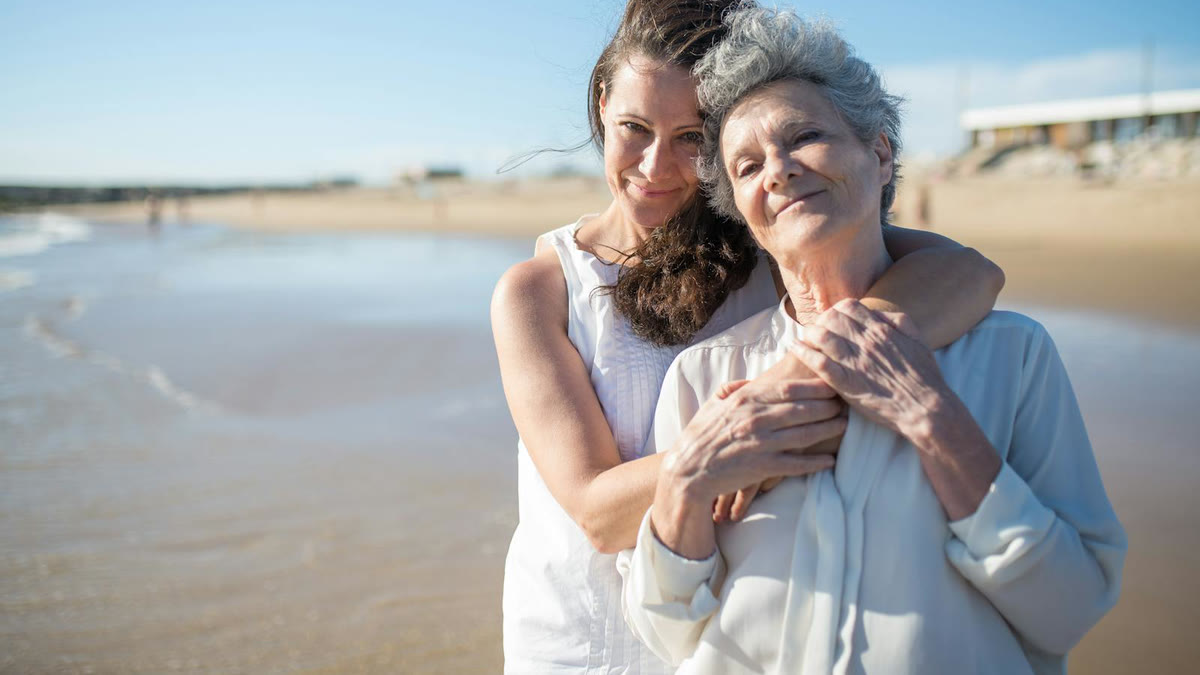
"My mother has Alzheimer's. Would estrogen have saved her?"
Some researchers think estrogen protects the aging brain, but only in a narrow window around menopause. My mother was inside that window in 2002. The evidence is still fiercely argued over. What nobody argues about is that she was never even offered the choice.
Some mornings are good mornings.
She sits across from me on the terrace, coffee in both hands, watching the light come up over Lake Chapala. The bougainvillea is ridiculous in May, purple-pink and climbing over everything, and she notices it. She says something funny. She has an opinion about the neighbor’s dog. For an hour, she is entirely herself.
Then some mornings she looks at me with a soft, searching look. She knows I’m her daughter. That recognition is still there, and I’m grateful for it every single day. But my name, the specific word that belongs to me, is somewhere she can’t reach anymore.
She’s 83. She has Alzheimer’s. She lives in my guest house here in Ajijic with a nursing team around her. She never took a single dose of hormone therapy.
I’ve been sitting with the same question for two years. It doesn’t go away.
Would her brain be different today if a doctor had offered her estrogen in 2002?
I’m going to answer that as honestly as I can, which means telling you the parts that feed my fear and the parts that cut against it. Both are real. If you’re going to make a decision about your own brain, you deserve the whole picture, not the half that makes a cleaner story.
How 2002 closed the door
In July 2002, the Women’s Health Initiative stopped one arm of its big hormone trial early and announced that hormone replacement therapy raised the risk of breast cancer, heart disease, and stroke. It was everywhere within a day. Every network, every front page.
Doctors stopped prescribing almost overnight. Women already on HRT were told to quit. Women showing up with hot flashes and wrecked sleep got the same sentence, over and over: too risky.
My mother was in her early 50s that year. She was having hot flashes. She wasn’t sleeping. She went to her doctors and asked for help, which is exactly what you’re supposed to do. She got the answer everyone got. Take nothing.
Here’s the part that took another decade to surface. The women in that 2002 trial were older than the women who got frightened by it. Their average age was 63. Many were more than a decade past menopause. The trial was mostly measuring what happens when you start hormones in your 60s, not in your early 50s.
That distinction turns out to matter enormously, and it sits at the center of everything that follows.
The timing hypothesis, and why it’s still a hypothesis
There’s an idea in menopause medicine called the timing hypothesis, or the critical window. It goes like this.
Estrogen does real work in the brain. It supports the way neurons burn fuel, it appears to help clear amyloid-beta (the protein that clumps into Alzheimer’s plaques), and it supports the cholinergic system, the network of neurons that Alzheimer’s tends to damage first and worst.
The hypothesis says estrogen can only defend that system while it’s still intact. Start estrogen in the first several years after menopause, while the receptors are still responsive, and it may help. Start it fifteen years later, after the architecture has already begun to break down, and it doesn’t help and might even hurt.
If that’s true, then 2002 wasn’t just overcautious. It pulled a possibly protective hormone away from millions of women during the exact years the hypothesis says it would have mattered most.
I have to be careful here, because this is precisely where it’s easy to say more than the evidence supports. So let me lay out both sides the way I’d want them laid out for me.
What supports it
The observational data leans toward timing.
When researchers follow large groups of women who chose to take hormones and compare them to women who didn’t, the ones who started HRT within about ten years of menopause tend to show lower rates of dementia. Pooled analyses have put that reduction at roughly a third for dementia overall, and higher for Alzheimer’s specifically. Estrogen-only therapy tends to look better than estrogen combined with a progestogen.
The mechanism is plausible and well studied. The link between estrogen and the cholinergic system is real, not folklore. This isn’t a fringe position. It’s a serious one, held by serious people, including Roberta Diaz Brinton and Lisa Mosconi, who have spent entire careers on the female brain.
That’s the case that keeps me up at night about my mother.
What undercuts it
Now the other half, and it’s substantial.
Observational studies carry a built-in flaw. The women who take hormones tend to be healthier, wealthier, and more engaged with their own care in the first place. That “healthy user” effect can manufacture the appearance of protection that isn’t actually coming from the drug.
The stronger design, the randomized controlled trial, has not confirmed the benefit. A 2023 systematic review and meta-analysis led by Matilde Nerattini and Lisa Mosconi looked straight at this question. The observational studies showed reduced risk with estrogen-only therapy. But the randomized trials, pooled together, still showed increased dementia risk overall in women over 65. And when the researchers zoomed into the midlife, early-start subgroup, the exact group the timing hypothesis is about, the result split in two. Estrogen alone showed a statistically significant benefit. Estrogen plus a progestogen, which is what most women with an intact uterus actually take, showed nothing significant in either direction.
That is not a confirmed protective effect. It’s a genuinely mixed one.
And the organizations whose job is to weigh this evidence have landed on caution.
- The Menopause Society (formerly NAMS) treats the critical-window idea as one of two competing explanations in its position statement, not as settled fact, and states plainly that hormone therapy is not recommended at any age specifically to prevent or treat cognitive decline or dementia.
- The U.S. Preventive Services Task Force continues to recommend against hormone therapy for chronic disease prevention, noting that the timing-hypothesis trials have been short and have leaned on surrogate markers rather than real dementia outcomes.
- The UK’s Alzheimer’s Society says directly that HRT is not recommended as a way to reduce dementia risk until the evidence is clearer.
Individual researchers who know this literature cold say the same. Dr. JoAnn Manson of Harvard, one of the original WHI investigators, keeps pointing out that the timing trials are too short and too dependent on surrogate outcomes to prove long-term protection. A 2023 review by Wong and colleagues concluded there’s “insufficient evidence to confidently prompt the use of estrogen to reduce the risk of Alzheimer’s disease.” Physician writers like Dr. Jen Gunter and Dr. Heather Hirsch have both pushed back, in public, on telling women that hormones are proven to protect the brain. Because they aren’t.
So here’s the honest summary. The timing hypothesis is a serious, actively researched idea with real observational support and a plausible mechanism. It has not cleared the bar of confirmed, replicated randomized evidence for preventing dementia, and the bodies that write the guidelines currently decline to recommend hormones for that purpose.
That’s a very different statement from “the science is settled.” Anyone who tells you it’s settled, in either direction, is selling you their conclusion.
The WHIMS trap, and the mistake I refuse to make in reverse
There’s one more study worth understanding, because it gets waved around constantly.
The Women’s Health Initiative Memory Study, WHIMS, was an add-on to the original WHI. It found that hormone therapy increased dementia risk, and that finding traveled just as far as the 2002 headline did.
Here’s who WHIMS enrolled: women with an average age of 71. That’s well outside the proposed window. For a large share of them, menopause was fifteen or twenty years behind them. You can’t test a time-limited intervention by studying people who are already past the time limit, and then turn around and apply the result to women who are inside it.
That’s the same error as 2002, pointed the same direction. Study older women. Find harm. Apply it to younger ones.
But I have to be just as strict with myself going the other way. The fact that WHIMS studied the wrong age group does not prove the timing hypothesis is right. It only means WHIMS can’t disprove it. “Their evidence against is flawed” is not the same thing as “my evidence for is solid.” The moment I forget that, I’m committing the 2002 mistake in reverse, just with a conclusion I happen to like better.
The timing hypothesis remains, at best, promising and unproven. I’m not going to pretend otherwise to make my own decision feel safer.
Why I take estrogen anyway
So why did I start hormone therapy myself, knowing all of that?
Because I’m not a trial. I’m one person making a decision under uncertainty, and my numbers are not the average woman’s numbers.
I carry two copies of the APOE4 gene. Homozygous APOE4 is the highest common genetic risk profile for Alzheimer’s there is, somewhere around ten to fifteen times the baseline risk, possibly higher. My mother has Alzheimer’s. My aunt died of it in 2022. I’ve watched this disease take my mother’s words, her recent memories, her ability to hold the thread of a conversation. I know what the early and middle stages look like from inside a family.
I’m 57. If the window is real, I’m either inside it or standing right at the edge.
When the evidence is genuinely uncertain, the decision comes down to trade-offs: what you’re risking against what you might gain, for you specifically. For a woman at average risk, the guideline bodies are right to be cautious. Don’t take a drug for an unproven benefit. For me, with this genotype and this family history and this age, the same facts read differently. I worked through them with a certified menopause specialist, not a general practitioner running on a 2005 reflex, and I chose to start.
I want to be precise about what that choice is and isn’t. It isn’t proof, and it isn’t advice for you. It’s a personal bet, made with open eyes on incomplete evidence, because the outcome I’m trying to avoid is sitting across from me on the terrace every morning.
You could weigh the same facts and choose differently. That’s allowed. That’s the whole point. It should have been my mother’s to weigh too.
What “she was never given the choice” actually means
This is the part I’m most certain of, and it doesn’t depend on who turns out to be right about the hormones.
My mother didn’t make a bad decision. She made no decision at all. She asked for help and was told no. She was symptomatic, in her early 50s, doing everything a patient is supposed to do, trusting the people with the training.
I don’t blame her doctors as individuals. They were practicing on the best information they had, and that information had just been detonated by a federal study. I’m angry at the system that took a result from older women and hardened it into a blanket rule for younger ones. A 2002 headline became a 2005 guideline, then a 2010 norm, then a 2015 reflex, without anyone going back to check whether the ages even matched.
The women who lost the most weren’t handed a wrong answer to weigh. They were handed no answer at all. The conversation simply never happened.
Whatever the trials eventually prove about the brain, that failure is a fact on its own.
February 2026, and what actually changed
In February 2026, the FDA formally approved the label changes removing the boxed warning from hormone therapy products, both vaginal and systemic, the formal step behind the class-wide removal HHS and the FDA had announced in November 2025. The updated labeling acknowledges that women who start within ten years of menopause may see benefits, including lower cardiovascular risk and fewer fractures, along with language about possible cognitive benefit.
That’s a real shift after twenty-three years, and it walks back some of the fear that 2002 created.
But notice what it does not do. It does not mean the guideline bodies now recommend hormones to prevent dementia. As of this writing, the Menopause Society, the USPSTF, and the Alzheimer’s Society still don’t. A label that acknowledges possible benefit and a guideline that recommends a drug for prevention are two very different documents, and I’d be doing exactly what I criticize if I smeared them together.
My mother is 83. Whatever the window was, it closed for her two decades ago. The question I keep asking has no answer, and I’ve made my peace with that. I can’t know what her brain would look like today if a doctor in 2002 had sat down and actually talked it through with her. I only know that nobody did.
If you’re anywhere near the window
Here’s what I’d want a friend to hear.
If you’re in your late 40s or 50s, or you went through menopause in the last decade, and no one has ever walked you through hormone therapy as a genuine decision with genuine trade-offs, that gap is worth closing while you still have options in front of you.
Not because hormones are proven to protect your brain. They aren’t. But because the decision about your own body and your own risk should be yours to make with good information, and for a lot of women that conversation still isn’t happening at all.
A few things that make it a better conversation:
- Find a clinician who actually knows this literature, ideally a certified menopause specialist, not a GP working from “lowest dose, shortest time.” The Menopause Society keeps a provider finder at menopause.org. Midi Health covers the US by telehealth, and Newson Health does international telehealth from the UK.
- Bring your own risk to the table: family history, and if you know it, your APOE status. The math genuinely differs from woman to woman, and a good specialist will treat it that way.
- Ask them directly where the evidence is strong, where it’s mixed, and what the guideline bodies currently say. If they tell you it’s all settled, in either direction, go find someone more honest.
I couldn’t give my mother that conversation. Nobody offered it to her. What I can do is make sure the women reading this know it exists, know it’s theirs to have, and know exactly how uncertain, and how serious, the underlying question really is.
The window may be real. The evidence is still unfinished. And the choice, at the very least, should always be yours.
Annette Thompson is 57, the founder of adoption.com, and a menopause advocate writing about evidence-based women’s health. She carries two copies of the APOE4 gene and reads the primary research so you don’t have to take anyone’s headline at face value.
If this was useful, SmartStrongAlive is where I work through this kind of research in the open, one question at a time. And if you know a woman in her 50s who’s never been offered a real conversation about hormones, forward this to her. That conversation is the whole point.
Sources: Nerattini M, Mosconi L, et al. “Systematic review and meta-analysis of the effects of menopause hormone therapy on risk of Alzheimer’s disease and dementia.” Frontiers in Aging Neuroscience, 2023 (PMC10625913) | The Menopause Society (NAMS). 2022 Hormone Therapy Position Statement | U.S. Preventive Services Task Force. Recommendation on hormone therapy for the primary prevention of chronic conditions | Alzheimer’s Society (UK). HRT and dementia risk guidance | Manson JE, commentary in JAMA on menopause hormone therapy and cognition | Wong NKP, et al. Review on estrogen and Alzheimer’s disease risk, 2023 | Brinton RD, Yao J, Yin F, et al. “Perimenopause as a neurological transition state.” Nature Reviews Endocrinology, 2015 | Shumaker SA, et al. “Estrogen plus progestin and the incidence of dementia and mild cognitive impairment in postmenopausal women” (WHIMS). JAMA, 2003 (PMID 12771112) | Henderson VW. “Alzheimer’s disease: review of hormone therapy trials.” J Steroid Biochem Mol Biol, 2014 (PMID 23707452) | FDA hormone therapy label update, February 2026
Keep reading

Get the research, not the reassurance.
Every issue is free and every claim is sourced. Join women 40+ who are reading the science, asking better questions, and refusing to accept "it's just aging" as an answer.
Subscribe free on Substack